



-
- Discounted Collections
- Website Specials
- New for 2026!
- Tulips
- Narcissi
- Allium
- Anemone blanda
- Brodiaea
- Camassia
- Chionodoxa
- Corydalis
- Crocus
- Dichelostemma
- Eranthis
- Eremurus
- Erythronium
- Fritillaria
- Galanthus
- Gladiolus
- Hyacinths
- Hyacinthoides
- Ipheion uniflorum
- Dutch Iris
- Rock Garden Iris
- Ixiolirion
- Leucojum aestivum
- Muscari
- Ornithogalum
- Oxalis
- Puschkinia
- Scilla
- Triteleia
- Lilies
- Peonies
- Amaryllis
- Paperwhites
- Tender Bulbs
- Anemone Giants
- Tecolote Ranunculus
- Freesias
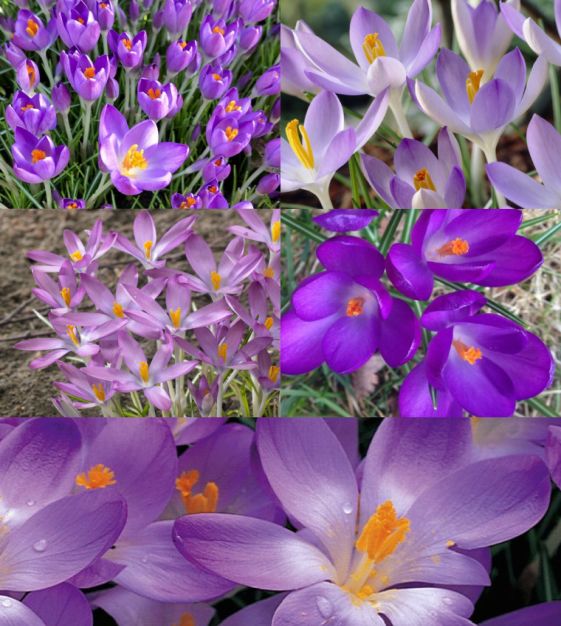
Collection Q: The Crocus tommasinianus Lawn-of-Dreams
Popularly regarded as NOT squirrel food, our hard-to-find spectrum of Species Crocus tommasinianus will festoon lawns with glistening gems of pale lilac to deep reddish-purple with every shade in between.
Estimated planting area: 55 square feet. Bulb size: 5 cm/up. Bloom time: March-April. Plant bulbs about 5" deep and 5" apart. Horticultural zones: 4-8. Height: 4". Please note that our collections are shipped in mid-October. (Each variety's photo appears in order as listed from left to right, and top to bottom.)
• 100 Crocus tommasinianus Barr's Purple: Amethyst-violet.
• 100 Crocus tommasinianus Lilac Beauty: Soft lilac.
• 100 Crocus tommasinianus Hummingbird: Shades of lilac.
• 100 Crocus tommasinianus Ruby Giant: Spectrum-violet.
• 100 Crocus tommasinianus Whitewell Purple: Pale silvery-mauve.
Crocus are The Art & Soul of Spring.
Crocus Horticultural Tips
- Information
There is nothing better after a long winter than to see the first Species Crocus poking their little heads through the soil. How lucky we are that Large Flowering Crocus follow about two weeks later for a slightly larger, encore performance! Both are terrific naturalizers. Species Crocus may be planted en masse in lawns (hold off mowing until the foliage dies back naturally). Both Species and Large Flowering Crocus may be incorporated into rock gardens, garden beds and pathside borders for early spring color. Crocus bulbs are really “corms” with either a smooth (annulate) tunic or a fibrous (reticulate or netted) tunic. Meaning saffron in Greek, Crocus sativus (not in our collection) is the variety used in harvesting the expensive spice threads that are the flower’s stigmas. One would need 75,000 flowers to yield just one pound of saffron! We’ve separated Species Crocus and Large Flowering Crocus into their own little sections to make variety selection a little easier.
Crocus are The Art & Soul of Spring.
Crocus Horticultural Tips Stinze Plantings
Crocus are The Art & Soul of Spring.
Crocus Horticultural Tips Stinze Plantings
There is nothing better after a long winter than to see the first Species Crocus poking their little heads through the soil. How lucky we are that Large Flowering Crocus follow about two weeks later for a slightly larger, encore performance! Both are terrific naturalizers. Species Crocus may be planted en masse in lawns (hold off mowing until the foliage dies back naturally). Both Species and Large Flowering Crocus may be incorporated into rock gardens, garden beds and pathside borders for early spring color. Crocus bulbs are really “corms” with either a smooth (annulate) tunic or a fibrous (reticulate or netted) tunic. Meaning saffron in Greek, Crocus sativus (not in our collection) is the variety used in harvesting the expensive spice threads that are the flower’s stigmas. One would need 75,000 flowers to yield just one pound of saffron! We’ve separated Species Crocus and Large Flowering Crocus into their own little sections to make variety selection a little easier.
Crocus are The Art & Soul of Spring.
Crocus Horticultural Tips Stinze Plantings
Crocus are The Art & Soul of Spring.
Crocus Horticultural Tips Stinze Plantings
